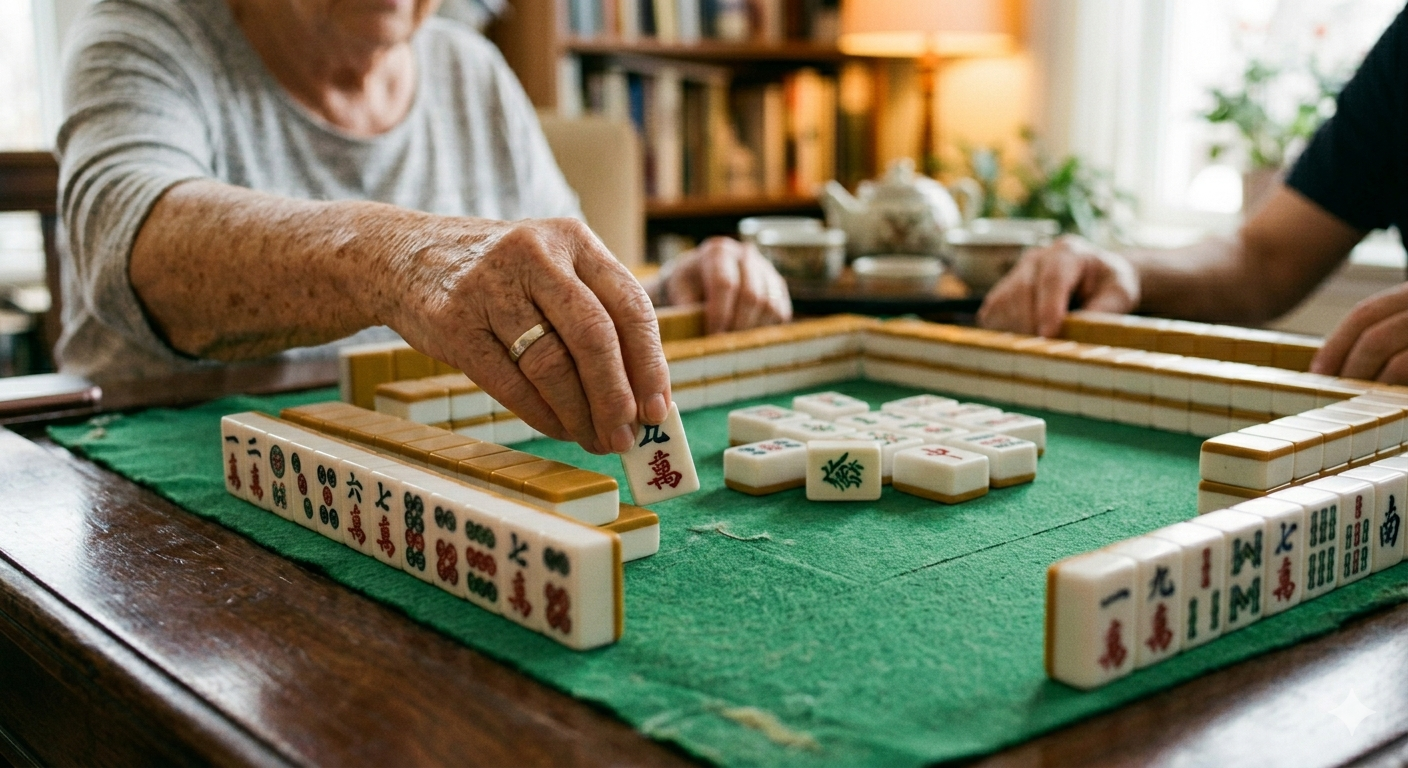
The sound is unmistakable – a sharp, rhythmic clicking, like bone striking jade, echoing through a crowded community center or rising softly from a family living room. It’s the soundtrack of Mahjong, a game woven deep into the fabric of East Asian culture, carrying centuries of tradition, strategy, and connection on its ivory (or plastic) tiles.
For many, including myself, Mahjong isn’t just a game; it’s a doorway to memory, a link across generations. My own introduction came late one rainy afternoon, guided by my grandmother, whose wrinkled hands moved over the tiles with practiced grace. “Wait, watch, and learn the logic,” she’d say, her eyes focused on the patterns unfolding. “It’s about understanding the current of the game, like a river.”
From Imperial Gardens to Modern Tables: A History of Strategy
Mahjong’s origins are veiled in the mists of 19th-century China. While some legends weave tales of Confucius playing, the game as we know it likely emerged in the coastal provinces near Shanghai during the late Qing Dynasty. It’s a synthesis of earlier card and domino games, refined into a four-player pastime of intricate strategy and social interaction.
The 1920s saw Mahjong travel across the oceans, finding passionate players in America and beyond, particularly within Jewish and other immigrant communities who embraced its mental stimulation and social camaraderie. Since then, various regional variations – Cantonese, Japanese Riichi, American, and more – have blossomed, each adding unique rules and cultural nuances.
The Logic Within: Finding Order in Chaos
At first glance, a Mahjong table, laden with 136 or more tiles bearing Chinese characters and symbols, can seem daunting. But the game’s core logic is surprisingly intuitive, built upon a foundation of sets.
The tiles belong to four categories:
- Suits (Dots, Bamboo, Characters): Three suited runs, numbered 1 to 9. Think of them like numbered playing cards.
- Honors (Winds, Dragons): Four Wind tiles (East, South, West, North) and three Dragon tiles (Red, Green, White).
- Flowers & Seasons: Special tiles that often offer bonus points but aren’t part of standard sets (rules vary by style).
The goal, like in Rummy, is to assemble a complete hand, typically 14 tiles, arranged into sets. A standard hand usually consists of:
- Pungs/Pongs: Three identical tiles (e.g., three ‘7 of Bamboo’ or three ‘Red Dragons’).
- Chows/Chis: A run of three consecutive tiles in the same suit (e.g., ‘4, 5, 6 of Dots’ or ‘1, 2, 3 of Characters’).
- A Pair: Two identical tiles that form the ‘eye’ of the hand.
The game is a dynamic puzzle. Players draw tiles, often discarding one simultaneously, constantly evaluating their hand against the shifting possibilities presented by the discards and the hidden stock. It’s about probability, pattern recognition, and subtle observation. You’re not just building your hand; you’re anticipating your opponents’ moves, guarding your discards, and sometimes, taking a calculated risk to finish first.
More Than Just Winning: The Heart of the Game
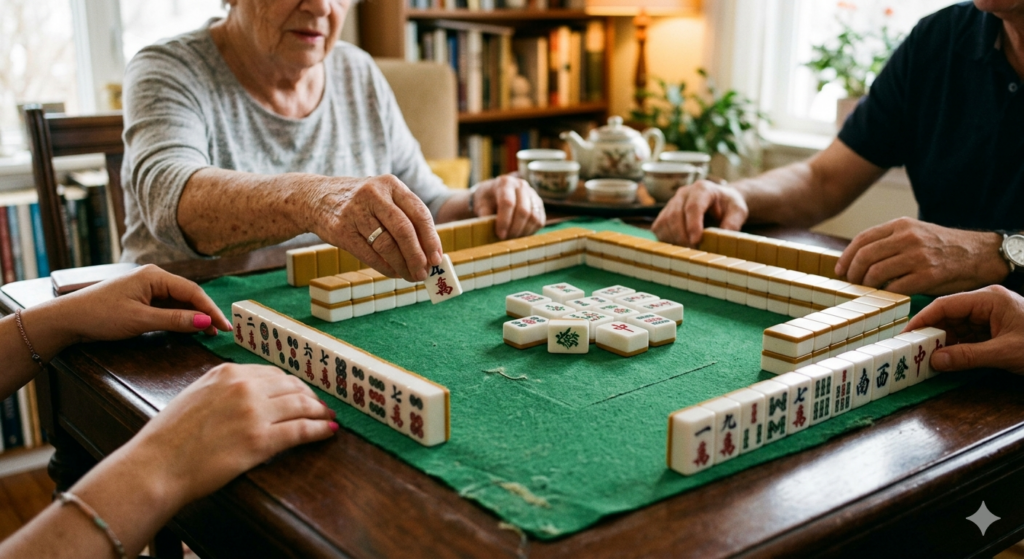
But the true magic of Mahjong lies in the empty spaces between the moves. It’s the casual chatter that flows across the table, the shared groans when a desired tile is discarded by someone else, and the focused silence when the endgame approaches. It’s about the patience learned while waiting for that elusive tile, and the resilience fostered when a carefully constructed hand is dismantled by a quick call from an opponent.
Mahjong is a testament to the power of shared activity. It bridges ages, languages, and cultures, offering a structured space for competition and companionship. It’s a reminder that sometimes, the most profound connections are made not through grandiose gestures, but over small, clicked tiles, as the river of memory flows gently on.

I am Nikita Bobrov and have been running this blog about Schufa and finances since 2009.
After completing my Master’s in Business Administration and additionally a B.Sc. in Computer Science, I made several moves between completely different countries and settled in Germany.
Germany is a country with complex legislation and a special love for paperwork and bureaucracy.
On the pages of this blog, the authors: Schufa Guide: Tips & Tricks, try to help you understand the document system in Germany and make life easier for ordinary people.
If we could help you, share useful information (e.g. displaying calendar weeks in Windows) with your friends on social networks, and perhaps they will thank you too!
Leave a Reply